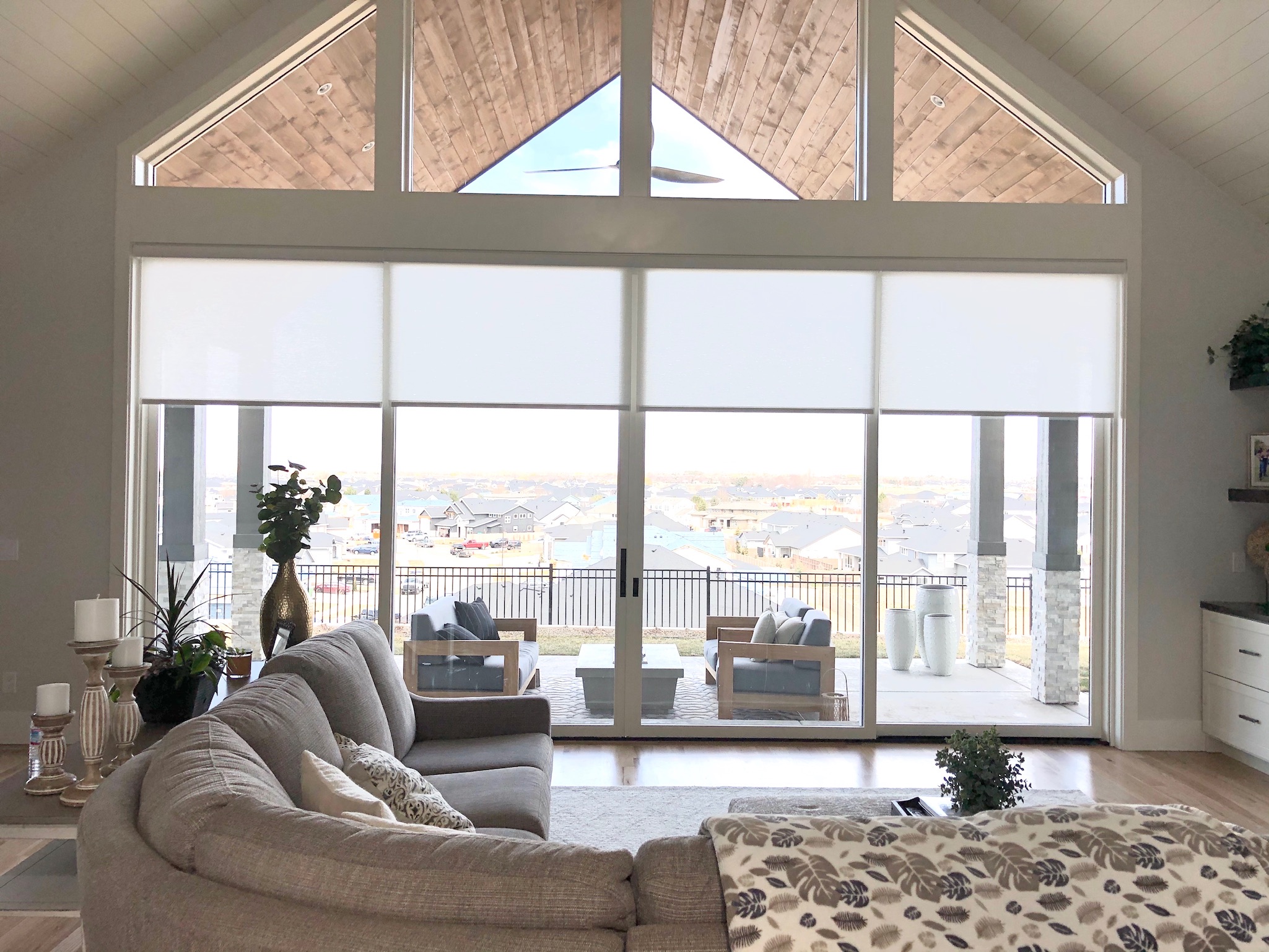
When you finally decide to cover that bare sliding glass door, the first fork in the road is simple: motorized or manual? Both options work. Both look great. But they serve different lifestyles, budgets, and priorities. After installing hundreds of sliding door treatments across the Treasure Valley, here's what we've learned about which homeowners are happiest with which choice.
The Case for Motorized Shades on Sliding Doors
Sliding glass doors are wide — typically 6 to 12 feet. That's a lot of shade to raise and lower by hand, especially if you're reaching across furniture or a dining table to get to a chain or wand. Motorized shades eliminate this problem entirely. You tap your phone, press a remote, or say 'Alexa, close the living room shades' — and the shade glides down silently.
For sliding doors specifically, motorization isn't just a luxury — it's often the most practical choice. Here's why: a 10-foot-wide shade with a manual chain requires you to physically stand at one end of the door to operate it. If your couch is in front of the door (as it often is in open floor plans), you're climbing over furniture twice a day. Motorization solves this completely.
Motorized Advantages for Sliding Doors
- •No reaching across wide spans — operate from anywhere in the room via phone, remote, or voice
- •Smart home integration — schedule shades to lower at sunset or raise at sunrise automatically
- •Child and pet safe — no dangling chains or cords near the floor
- •Consistent positioning — motorized shades stop at the exact same point every time, eliminating uneven hems
- •Eligible Sombra rechargeable wireless motors offer up to 3 years between battery charges, based on one up and one down per day
The Case for Manual Shades on Sliding Doors
Manual shades still have a place — particularly for homeowners on a tighter budget or those who prefer simplicity. A manual roller shade on a sliding door uses a continuous loop chain or a spring-assist mechanism. You pull it down, it stays. You tug the chain, it rolls up. No batteries, no app, no connectivity issues.
Manual operation works best on narrower sliding doors (6 feet or less) where you can easily reach the chain from a standing position. It's also a good fit for secondary sliding doors — like a basement walkout or a guest room patio door — where you're not adjusting the shade multiple times per day.
Manual Advantages for Sliding Doors
- •Lower upfront cost — typically $200-$335 less per shade than motorized
- •No batteries to recharge or replace
- •No technology to troubleshoot — no app updates, no Wi-Fi dependency
- •Immediate operation — no pairing, no setup, just pull and go
- •Simpler installation — no motor housing means a slightly smaller headrail profile
Cost Comparison: Motorized vs. Manual for a Standard Sliding Door
For a standard 6-foot sliding glass door in a Boise-area home, here's a realistic price range for a quality roller shade (installed):
- •Manual roller shade (chain or spring): $335–$540 installed
- •Motorized roller shade (battery, with remote): $540–$810 installed
- •Motorized roller shade (battery, with smart home hub): $600–$945 installed
For wider doors (8–12 feet), the price difference between manual and motorized narrows proportionally because the shade fabric and hardware costs increase regardless of operation type. On a 10-foot door, you might pay $675 for manual vs. $875 for motorized — a smaller percentage gap that makes motorization an easier decision.
When Motorized Is the Clear Winner
- •Your sliding door is 8 feet wide or more
- •Furniture blocks easy access to the shade chain
- •You want automated schedules (close at sunset, open at sunrise)
- •You have young children or pets (no cords)
- •You already have a smart home system (Alexa, Google Home, Apple HomeKit)
- •The sliding door is in a primary living space you use daily
When Manual Makes More Sense
- •Your sliding door is 6 feet or narrower
- •The door is in a secondary room (guest bedroom, basement)
- •Budget is the primary constraint
- •You prefer zero technology in your window treatments
- •The shade will rarely be adjusted (set it and forget it)
What About Panel Tracks and Vertiglide?
The motorized vs. manual question applies primarily to roller shades. For panel track systems, most are manual by default — the panels glide along a track by hand, similar to how the door itself operates. Motorized panel tracks exist but are less common and significantly more expensive. Hunter Douglas Vertiglide (vertical honeycomb shades) is primarily a manual product that traverses side-to-side by hand, though PowerView motorization is available as an upgrade.
For a complete overview of all three sliding door solutions — motorized roller shades, panel tracks, and vertical honeycomb — visit our dedicated Sliding Glass Door Solutions page.
Our Recommendation for Most Boise Homeowners
For primary living areas with sliding doors wider than 6 feet, we recommend motorized roller shades about 80% of the time. The convenience factor on a wide door is significant — you'll use the shade more consistently when it's effortless to operate, which means better UV protection, better energy efficiency, and better privacy. The battery-powered options (like our Sombra Shades) have eliminated the old barrier of expensive hardwiring, making motorization accessible at a reasonable price point.
For secondary doors, narrow openings, or budget-conscious projects, manual roller shades remain an excellent choice. The shade itself looks identical whether motorized or manual — the difference is purely in how you operate it.
Not sure which is right for your sliding door? We bring both motorized and manual samples to every free in-home consultation so you can see and feel the difference. Call (208) 501-5684 or visit our Sliding Glass Door Solutions page to explore all options.
Frequently Asked Questions
How long do motorized shade batteries last on a sliding door?
Eligible Sombra rechargeable wireless motor configurations offer up to 3 years between battery charges, based on one up and one down per day. Actual time between charges depends on shade size, use, and whether the battery was fully charged.
Can I add motorization to an existing manual shade later?
In most cases, no — the motor is built into the roller tube during manufacturing. If you think you might want motorization in the future, it's more cost-effective to choose motorized from the start rather than replacing the entire shade later.
Do motorized shades work during a power outage?
Sombra Shades use rechargeable battery power and work independently of your home's electrical system during a power outage. Some other motorized product lines can be hardwired; those systems will not operate during an outage unless connected to a backup power source.