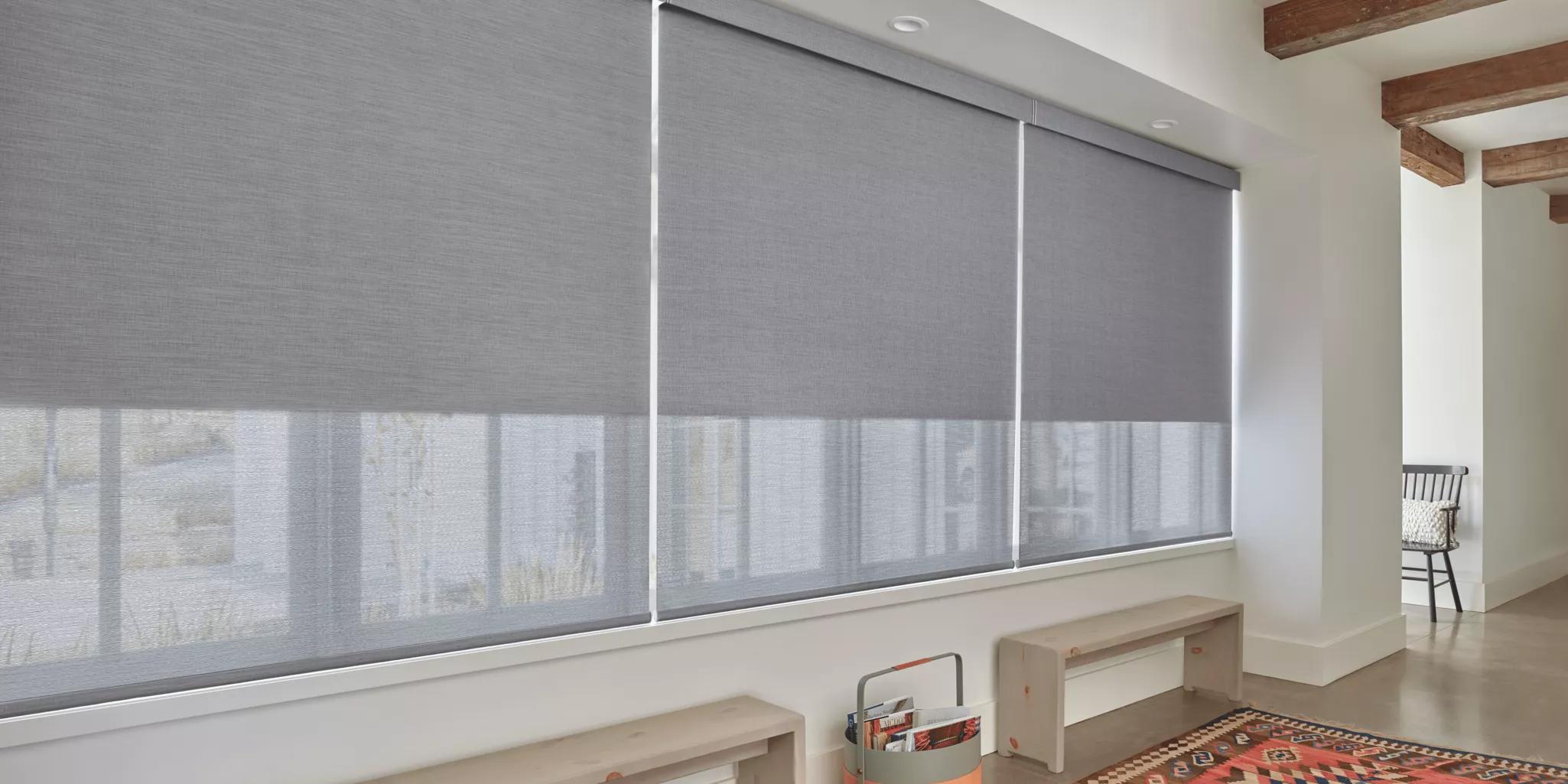
After installing window treatments on hundreds of sliding glass doors across Boise, Eagle, Meridian, Star, and Nampa, we've seen the same mistakes repeated by well-intentioned homeowners. These aren't catastrophic errors — but they lead to buyer's remorse, wasted money, and treatments that get removed within a few years. Here are the five most common ones and how to avoid them.
Mistake #1: Buying Cheap Vertical Blinds as a Replacement
This is the most common mistake by far. A homeowner removes the dated vertical blinds that came with the house, lives with a bare door for a while, then eventually buys another set of vertical blinds from a big box store because they're the cheapest option that fits the opening. Within two years, the plastic vanes are cracked, the carrier clips are broken, and the whole thing looks worse than having no covering at all.
The problem isn't vertical blinds as a concept — it's the quality. Cheap PVC vanes warp in Idaho's temperature swings, the carrier mechanisms jam, and the headrail bows under the weight of a 6-foot-wide set of vanes. If you want a vertical solution, invest in a quality product like Hunter Douglas Vertiglide (vertical honeycomb) or a panel track system. They operate on the same side-to-side principle but with dramatically better materials and mechanisms.
What to Do Instead
Consider a motorized roller shade, panel track system, or Hunter Douglas Vertiglide. All three are purpose-built for large openings and use materials that hold up for 10-15 years. The upfront cost is higher than big-box vertical blinds, but the per-year cost is actually lower when you factor in replacement cycles.
Mistake #2: Measuring the Glass Instead of the Opening
Sliding glass doors have frames, tracks, and trim that extend beyond the glass panels. Homeowners who measure only the glass end up with a shade that's too narrow — leaving light gaps on both sides and an unfinished look. This is especially common with online shade orders where there's no professional measurement involved.
For roller shades on sliding doors, the shade should be mounted above the door frame and extend 2-3 inches beyond the frame on each side. This provides full coverage, eliminates light gaps, and creates a cleaner visual line. For an inside-mount (where the shade sits within the frame), the measurement needs to account for the track hardware and any obstructions that prevent the shade from sitting flush.
What to Do Instead
Get a professional measurement. This isn't a sales pitch — it's genuinely the difference between a shade that looks custom and one that looks like an afterthought. Every sliding door has quirks: uneven frames, recessed tracks, trim profiles that affect mounting depth. A 15-minute professional measurement catches all of these. Ours are free and come with no obligation.
Mistake #3: Ignoring the Door's Operation When Choosing a Treatment
A sliding glass door is a door first and a window second. It needs to open and close freely, multiple times per day. Homeowners sometimes choose treatments that look beautiful when closed but interfere with actually using the door. Floor-length curtains that bunch on the track. Roman shades that hang too low when raised. Blinds with bottom rails that catch on the door handle.
The best sliding door treatments are designed to get completely out of the way when the door is in use. A roller shade rolls up into a compact cassette above the frame — zero interference. A panel track stacks to one side. Vertiglide panels compress into a tight stack. All three solutions give you full, unobstructed access to the door when open.
What to Do Instead
Before choosing any treatment, ask: 'Where does this go when I want to use the door?' If the answer involves pushing fabric aside, holding something up, or stepping over a bottom rail, it's the wrong solution for a sliding door. The treatment should disappear — either rolling up, stacking to the side, or compressing into a minimal profile.
Mistake #4: Choosing Manual Operation on a Wide Door
A 6-foot sliding door with a manual chain? Manageable. A 10-foot sliding door with a manual chain? You'll stop using it within a month. We see this constantly: homeowners save $270 by choosing manual operation on a wide door, then never adjust the shade because it's too inconvenient to walk to the end of the door, reach behind the couch, and pull a chain.
The result is a shade that stays in one position permanently — either always down (blocking your view and natural light) or always up (providing no privacy or UV protection). The whole point of a window treatment is to adjust it throughout the day based on sun position, privacy needs, and temperature. If the operation is inconvenient, you won't adjust it.
What to Do Instead
For any sliding door wider than 6 feet in a primary living space, strongly consider motorized operation. Eligible Sombra rechargeable wireless motor configurations offer up to 3 years between battery charges, based on one up and one down per day. Actual time between charges depends on shade size, use, and whether the battery was fully charged. The convenience of phone, voice, or remote control means you'll actually use the shade as intended — adjusting it throughout the day for optimal comfort.
Mistake #5: Prioritizing Price Over Longevity
Sliding glass doors are high-traffic, high-UV, high-use locations. The treatment you put on a slider gets more abuse than any other window covering in your home — it's operated more frequently, exposed to more direct sun, and subject to more accidental contact from people walking through the door. Cheap materials fail fast in this environment.
We regularly replace treatments on sliding doors that are only 2-3 years old — faded fabrics, broken mechanisms, warped components. In almost every case, the homeowner chose the cheapest option available and is now paying for a second treatment. The total cost of two cheap treatments always exceeds the cost of one quality treatment that lasts 10-15 years.
What to Do Instead
Think in terms of cost per year, not upfront price. A $675 motorized roller shade that lasts 12 years costs $50 per year. A $270 set of vertical blinds that lasts 3 years costs $100 per year — and looks progressively worse each year as it degrades. Quality window treatments on a sliding door are a long-term investment that adds value to your home.
The Right Approach: Start With a Free Consultation
Every sliding glass door is different — different width, different height, different sun exposure, different furniture layout, different usage pattern. The right solution for your neighbor's slider might be completely wrong for yours. That's why we bring samples of all three solutions (roller shades, panel tracks, and vertical honeycomb) to every in-home consultation. You can see them against your door, test the operation, and compare fabrics in your actual lighting conditions.
For a complete overview of all three sliding door solutions with photos and a comparison chart, visit our Sliding Glass Door Solutions page. Or call (208) 501-5684 to schedule your free consultation — we serve all Treasure Valley communities including Boise, Eagle, Meridian, Star, Nampa, Caldwell, and Middleton.
Ready to cover your sliding glass door the right way? Visit our Sliding Glass Door Solutions page for a side-by-side comparison of all three options, or call (208) 501-5684 to schedule a free in-home consultation with samples.
Frequently Asked Questions
What is the best replacement for vertical blinds on a sliding door?
The three best replacements are motorized roller shades (most popular — clean look, disappears when raised), Hunter Douglas Vertiglide (vertical honeycomb — best energy efficiency), and panel track systems (architectural look — best for extra-wide openings). All three are dramatically better than replacement vertical blinds in terms of durability, aesthetics, and function.
How much does it cost to properly cover a sliding glass door in Boise?
For a standard 6-foot sliding door: motorized roller shades run $540-$810 installed, panel tracks $540-$1,080, and Hunter Douglas Vertiglide $675-$1,215. For wider doors (8-12 feet), expect $810-$1,620 depending on the solution and fabric. All prices include professional measurement and installation.
Should I get curtains or shades for my sliding glass door?
We generally recommend shades over curtains for sliding doors. Curtains can interfere with the door track, collect dust at floor level, and don't provide the same clean look when the door is in use. Roller shades roll up completely out of the way, while curtains need to be pushed aside and often bunch awkwardly.
Can you install shades on a 3-panel or 4-panel sliding door?
Yes. For multi-panel sliders, we typically recommend either a single wide motorized roller shade (up to 12 feet) or a Hunter Douglas Vertiglide in split-stack configuration (panels stack to both sides). Panel tracks also work well on extra-wide openings up to 16 feet.